The Coţofeni culture (Serbian: Kocofeni), generally associated with the Usatovo culture,[1][2] was an Early Bronze Age archaeological culture that existed between 3500 and 2500 BC in the mid-Danube area of south-eastern Central Europe.
The first report of a Coţofeni find was made by Fr. Schuster[3] in 1865 from the Râpa Roşie site in Sebeş (present-day Alba County, Romania). Since then this culture has been studied by a number of people to varying degrees. Some of the more prominent contributors to the study of this culture include C. Gooss, K. Benkő, B. Orbán, G. Téglas, K. Herepey, S. Fenichel, Julius Teutsch, Cezar Bolliac, V. Christescu, Teohari Antonescu, and Cristian Popa.
Geographic area
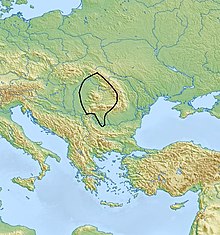
The Coţofeni culture area can be seen from two perspectives, as a fluctuation zone, or in its maximum area of extent. This covers present day Maramureş, some areas in Sătmar, the mountainous and hilly areas of Crişana, Transylvania,[4][5] Banat,[6] Oltenia,[7] Muntenia (not including the North-East), and across the Danube in present-day eastern Serbia and northwestern Bulgaria.[8]
Chronology
Absolute chronology


Bronze Age in Romania Unfortunately, most of the Coţofeni culture chronology is based on just three samples collected at three different Coţofeni sites. Based on these radiocarbon dates, this culture can be placed between roughly 3500 and 2500 BC.[9]
Relative chronology
Cultural synchronisms have been established based on mutual trade relations (visible as imported items) as well as stratigraphic observations. There is an evident synchronicity between:
Coţofeni I - Cernavoda III - Baden A - Spherical Amphorae;
Coţofeni II - Baden B-C Kostolac;[10][11]
Coţofeni III - Kostolac-Vučedol A-B.
Relations with contemporary neighbouring cultures
During the evolution of the Coţofeni culture, there were clearly relationships with other neighbouring cultures. The influence between the Coţofeni and their neighbours the Baden, Kostolac,[12] Vučedol, Globular Amphora culture as well as the Ochre Burial populations was reciprocal. The areas bordering these cultures show cultural traits that have mixed aspects, for example Coţofeni-Baden[13][14] and Coţofeni-Kostolac finds. These finds of mixed aspects suggest a cohabitation between related populations.[15] It also supports the idea of well established trade between cultures.
| This article uses material from the Wikipedia article Metasyntactic variable, which is released under the Creative Commons Attribution-ShareAlike 3.0 Unported License. |