The following tables give an overview of notable finds of hominin fossils and remains relating to human evolution, beginning with the formation of the tribe Hominini (the divergence of the human and chimpanzee lineages) in the late Miocene, roughly 7 to 8 million years ago.
As there are thousands of fossils, mostly fragmentary, often consisting of single bones or isolated teeth with complete skulls and skeletons rare, this overview is not complete, but show some of the most important findings. The fossils are arranged by approximate age as determined by radiometric dating and/or incremental dating and the species name represents current consensus; if there is no clear scientific consensus the other possible classifications are indicated.
The early fossils shown are not considered ancestors to Homo sapiens but are closely related to ancestors and are therefore important to the study of the lineage. After 1.5 million years ago (extinction of Paranthropus), all fossils shown are human (genus Homo). After 11,500 years ago (11.5 ka, beginning of the Holocene), all fossils shown are Homo sapiens (anatomically modern humans), illustrating recent divergence in the formation of modern human sub-populations.
Late Miocene (7.2–5.5 million years old)Edit
The chimpanzee–human divergence likely took place during about 10 to 7 million years ago.[1] The list of fossils begins with Graecopithecus, dated some 7.2 million years ago, which may or may not still be ancestral to both the human and the chimpanzee lineage. For the earlier history of the human lineage, see Timeline of human evolution#Hominidae, Hominidae#Phylogeny.
| Image | Name | Age (Ma) | Species | Year discovered | Country | Discovered by | Now located at |
|---|---|---|---|---|---|---|---|
 | El Graeco | 7.20 | Graecopithecus | 1944, 2017 | Greece, Bulgaria Site:Pyrgos Vassilissis, Azmaka | Böhme (Tübingen), Spassov (BAS) | Met, Athens; Tübingen, Germany |
 | TM 266 (Toumai) | 7.00-6.00[2] | Sahelanthropus tchadensis | 2001 | Chad Site:Djurab Desert | Michel Brunet, Alain Beauvilain, Fanone Gongdibe, Mahamat Adoum and Ahounta Djimdoumalbaye | N'Djamena (Chad), BEAC |
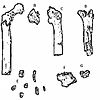 | BAR 1000'00 | 6.1 - 5.7[3] | Orrorin tugenensis | 2000 | Kenya Site:Lukeino | Martin Pickford, Kiptalam Cheboi, Dominique Gommery, Pierre Mein, Brigitte Senut, | |
| Trachilos footprints | 5.7 | Made by hominin or hominin-like primate | 2002 | Greece | Gerard D. Gierliński | ||
 | ALA-VP 1/20[4] | 5.65±0.150 | Ardipithecus kadabba | 1997 | Ethiopia Site:Middle Awash | Yohannes Haile-Selassie |
Pliocene (5.3–2.58 million years old)Edit
| Image | Name | Age (Ma) | Species | Year discovered | Country | Discovered by | Now located at |
|---|---|---|---|---|---|---|---|
 | Ardi | 4.40[5] | Ardipithecus ramidus | 1994 | Ethiopia | Yohannes Haile-Selassie | |
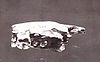 | Lothagam mandible (KNM-LT 329)[6] | 4.60±0.40[7] | Australopithecus anamensis or undetermined Hominidae | 1967 | Kenya | Arnold Lewis,[8] Bryan Patterson[9][10][11] | |
| KNM-TH 13150 | 4.70±0.55[12] | Australopithecus anamensis | 1984 | Kenya | Kiptalam Cheboi[9] | ||
 | KNM-KP 271 | 4.00[13] | Australopithecus anamensis | 1965 | Kanapoi, Kenya | Bryan Patterson[9] | |
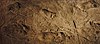 | Laetoli Footprints | 3.70 | Bipedal hominin | 1976 | Tanzania | Mary Leakey | |
 | LH 4 | 3.40±0.50 | Australopithecus afarensis | 1974 | Laetoli, Tanzania | Mary Leakey[14] | |
| KSD-VP-1/1 (Kadanuumuu) | 3.58 | Australopithecus afarensis | 2005 | Ethiopia | Yohannes Haile-Selassie | ||
| KT-12/H1 (Abel) | 3.50 | Australopithecus bahrelghazali | 1995 | Chad | Mamelbaye Tomalta and Michel Brunet | N'Djamena (Chad), BEAC | |
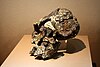 | KNM-WT 40000 (Flat Faced Man)[15] | 3.50-3.20 | Kenyanthropus platyops | 1999 | Lake Turkana (West Lake Turkana), Kenya | Justus Erus and Meave Leakey[16] | |
| BRT-VP-3/14 | 3.40±0.10 | Australopithecus deyiremeda | 2015 | Ethiopia | Yohannes Haile-Selassie[17] | ||
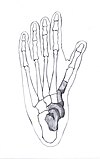 | Stw 573 (Little foot) | 3.67 | Australopithecus prometheus(?) | 1994 | Sterkfontein, South Africa | Ronald J. Clarke | |
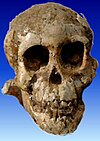 | DIK-1 (Selam) | 3.30 | Australopithecus afarensis | 2000 | Ethiopia | Zeresenay Alemseged | |
 | AL 288-1 (Lucy) | 3.20 | Australopithecus afarensis | 1974 | Ethiopia | Tom Gray, Donald Johanson, Yves Coppens and Maurice Taieb | National Museum of Ethiopia |
 | AL 200-1 | 3.10±0.10 | Australopithecus afarensis | 1975 | Afar Region, Ethiopia | Donald Johanson Yves Coppens and Maurice Taieb | |
| AL 129-1 | 3.10±0.10 | Australopithecus afarensis | 1973 | Afar Region, Ethiopia | Donald Johanson | ||
 | AL 444-2[18] | 3.00 | Australopithecus afarensis | 1992 | Afar Region, Ethiopia | Yoel Rak | |
| [19] | LD 350-1 | 2.775±0.025[20] | Homo(?) | 2013 | Ethiopia | Chalachew Seyoum | |
 | Taung Child 1 | 3.03 - 2.61 | Australopithecus africanus | 1924 | Buxton-Norlim Limeworks, South Africa | Raymond Dart | University of the Witwatersrand |
PleistoceneEdit
Lower Paleolithic: 2.58–0.3 million years oldEdit
| Name | Age (Ma) | Species | Date discovered | Country | Discovered by | Now located at | |
|---|---|---|---|---|---|---|---|
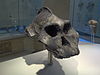 | KNM-WT 17000 (The Black Skull) | 2.50 | Paranthropus aethiopicus | 1985 | Kenya | Alan Walker | |
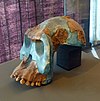 | BOU-VP-12/130[21] | 2.50 | Australopithecus garhi | 1997 | Ethiopia | Yohannes Haile-Selassie | |
 | STS 71[22] | 2.61 -2.07 | Australopithecus africanus | 1947 | Sterkfontein, South Africa | Robert Broom and John T. Robinson | Ditsong National Museum of Natural History |
 | STS 52 | 2.61 - 2.07 | Australopithecus africanus | 1947 | Sterkfontein, South Africa | Robert Broom | Ditsong National Museum of Natural History |
 | UR 501 (Uraha jawbone) | 2.40±0.10 | Homo rudolfensis[23] | 1991 | Malawi | Tyson Msiska, Timothy Bromage, Friedemann Schrenk | |
 | STS 5 (Mrs. Ples) (STS 14)[24] | 2.07[25] | Australopithecus africanus | 1947 | Sterkfontein, South Africa | Robert Broom | Ditsong National Museum of Natural History |
| DNH 134 (Simon)[26] | 2.04[26] | Homo erectus | 2015 | Drimolen ,Drimolen Main Quarry, South Africa | Andy Herries' team (excavated by Richard Curtis, Andy Herries, Angeline Leece; reconstructed by Jesse Martin) | University of the Witwatersrand | |
| DNH 155[27] | 2.04-1.95 | Paranthropus robustus | 2018 | Drimolen Main Quarry, South Africa | Andy Herries and Stephanie Bakers team (first found by Samantha Good and excavated by Samantha Good, Angeline Leece, Stephanie Baker and Andy Herries; reconstructed by Jesse Martin) | University of the Witwatersrand | |
| DNH 152 [26](Khethi) | 2.04-1.95[26] | Paranthropus robustus | 2018 | Drimolen Main Quarry, South Africa | Andy Herries' and Stephanie Baker's team (first part found by Khethi Nkosi. later parts by Amber Jaeger, Eunice Lalunio; reconstructed by Jesse Martin & Angeline Leece) | University of the Witwatersrand | |
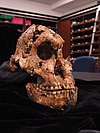 | DNH 7 (Eurydice)[28] | 2.04 - 1.95[26] | Paranthropus robustus | 1994 | Drimolen, Drimolen Main Quarry, South Africa | R. Smith and André Keyser | University of the Witwatersrand |
 | TM 1517[29] | 2.0 | Paranthropus robustus | 1938 | South Africa | Gert Terblanche | Ditsong National Museum of Natural History |
 | MH1 (Karabo)[30][31] | 1.98[32] | Australopithecus sediba | 2008 | Malapa, South Africa | Lee R. Berger | University of the Witwatersrand |
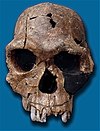 | KNM-ER 1813 | 1.90 | Homo habilis | 1973 | Kenya | Kamoya Kimeu | |
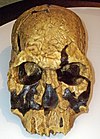 | KNM-ER 1470 | 1.90 | Homo rudolfensis | 1972 | Kenya | Bernard Ngeneo[33] | |
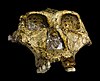 | SK 48 | 2.25 - 1.80 | Paranthropus robustus | 1948 | Swartkrans, South Africa | Robert Broom | Ditsong National Museum of Natural History |
 | SK 46[34] | 2.25 - 1.80 | Paranthropus robustus | 1949 | Swartkrans, South Africa | Robert Broom | Ditsong National Museum of Natural History |
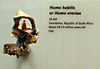 | SK 847[35] | 2.25 -1.80 | Homo habilis | 1949 | Swartkrans, South Africa | Ditsong National Museum of Natural History | |
 | OH 24 (Twiggy)[36] | 1.80 | Homo habilis | 1968 | Tanzania | Peter Nzube | |
 | OH 8[37] | 1.80 | Homo habilis | 1960 | Olduvai, Tanzania | ||
 | D2700 (Dmanisi Skull 3) | 1.81±0.40[38] | Homo erectus | 2001 | Dmanisi, Georgia | David Lordkipanidze and Abesalom Vekua | |
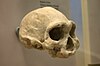 | D3444 (Dmanisi Skull 4) | 1.81±0.40 | Homo erectus | 2003 | Dmanisi, Georgia | David Lordkipanidze | |
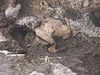 | D4500 (Dmanisi Skull 5) | 1.81±0.40 | Homo erectus | 2005 (published in 2013) | Dmanisi, Georgia | David Lordkipanidze | |
| KNM-ER 62000–62003[39] | 1.84±0.60 | Homo rudolfensis | 2012 | Koobi Fora, Kenya | Meave Leakey's team | ||
 | OH 5 (Zinj or nutcracker man) | 1.75 | Paranthropus boisei | 1959 | Tanzania | Mary Leakey | |
 | OH 7 | 1.75 | Homo habilis | 1960 | Tanzania | Jonathan Leakey | |
| StW 53 | 1.8 - 1.6[25] | variously A. africanus, H. habilis, H. gautengensis | 1976 | Sterkfontein, South Africa | A. R. Hughes | University of the Witwatersrand | |
 | KNM-ER 1805 | 1.74 | Homo habilis | 1973/4 | Kenya | Paul Abell | |
| Yuanmou Man | 1.70 or 0.60–0.50 (disputed)[40] | Homo erectus | 1965 | China | Fang Qian | ||
 | KNM-ER 406 | 1.70 | Paranthropus boisei | 1969 | Kenya | Richard Leakey | |
 | KNM-ER 732[41] | 1.70 | Paranthropus boisei | 1970 | Kenya | Richard Leakey | |
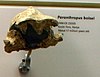 | KNM-ER 23000[42] | 1.70 | Paranthropus boisei | 1990 | Koobi Fora, Kenya | Benson Kyongo | |
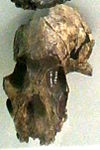 | KNM-WT 17400[43][44] | 1.70 | Paranthropus boisei | Not known[45] | Lake Turkana (West Lake Turkana) Kenya | unknown[45] | National Museums of Kenya, Nairobi (Kenia) |
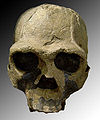 | KNM-ER 3733 | 1.63±0.15[46] | Homo ergaster (a.k.a. African Homo erectus) | 1975 | Kenya | ||
 | KNM-WT 15000 (Turkana Boy) | 1.60 | Homo ergaster (a.k.a. African Homo erectus) | 1984 | Lake Turkana (West Lake Turkana), Kenya | Kamoya Kimeu | Kenya National Museum |
 | Peninj Mandible | 1.50 | Paranthropus boisei | 1964 | Tanzania | Richard Leakey | |
 | KNM-ER 992 | 1.50 | Homo ergaster (a.k.a. African Homo erectus) | 1971 | Kenya | Richard Leakey | |
 | KNM-ER 3883 | 1.57±0.08 | Homo erectus | 1976 | Kenya | Richard Leakey | |
 | Mojokerto 1 (Mojokerto child) | 1.43±0.10 | Homo erectus | 1936 | Indonesia | Andojo, G.H.R. von Koenigswald | |
| KGA 10-525[47][48] | 1.40 | Paranthropus boisei | 1993 | Konso-Gardula, Ethiopia | A. Amzaye | ||
 | OH 9 (Chellean Man)[49] | 1.40 | Homo erectus | 1960 | Olduvai, Tanzania | Louis Leakey | |
 | Atapuerca Jawbone[50] | 1.20 | Homo sp. | 2008 | Spain | Eudald Carbonell | Museo de la Evolución Humana, Burgos (Spain) |
 | Kocabas | 1.10[51] | Homo erectus [52] | 2002 | Turkey | M. Cihat Alçiçek | |
 | Daka | 1.00 | Homo erectus | 1997 | Ethiopia | Henry Gilbert | |
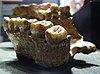 | Sangiran 4 | 1.00 | Homo erectus | 1939 | Indonesia | G.H.R. von Koenigswald | |
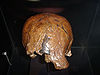 | Sangiran 2 | 1.15±0.45 | Homo erectus | 1937 | Indonesia | G.H.R. von Koenigswald | |
 | Madam Buya[53] | 1.00 | Homo erectus | 1997 | Eritrea | Ernesto Abbate | National Museum of Eritrea |
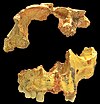 | ATD6-15 and ATD6-69 (Niño de la Gran Dolina 342) | 0.900[54] | Homo antecessor or Homo erectus | 1994 | Spain | Bermúdez & Arsuaga | Museo de la Evolución Humana, Burgos (Spain) |
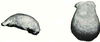 | Trinil 2 Pithecanthropus-1 or Java Man[55] | 0.850±0.150 | Homo erectus | 1891 | Indonesia | Eugène Dubois | Naturalis Biodiversity Center, Leiden |
 | Ternifine 2-3 now Tighennif[56] | 0.70 | Homo erectus | 1954 | Algeria | C. Arambourg & B. Hoffstetter | |
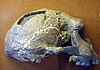 | Sangiran 17[57] | 0.70 | Homo erectus | 1969 | Indonesia | S. Sartono | |
 | Peking Man | 0.73±0.50[58] | Homo erectus | 1921 | China | Davidson Black | Lost/stolen |
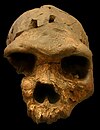 | Bodo[59] | 0.600 | Homo heidelbergensis or Homo erectus | 1976 | Ethiopia | A. Asfaw | |
 | Mauer 1 (Heidelberg Man) | 0.50 | Homo heidelbergensis | 1907 | Germany | Daniel Hartmann | Heidelberg University |
 | Saldanha man[60] | 0.50 | Homo rhodesiensis | 1953 | South Africa | ||
 | Boxgrove Man | 0.50[61] | Homo heidelbergensis | 1994 | UK | Natural History Museum | |
 | Arago 21 (Tautavel Man) | 0.45 | Homo erectus | 1971 | France | Henry de Lumley | |
| Argil Ceprano Man[62][63] | 0.450±0.050 | Homo cepranensis /Homo heidelbergensis | 1994 | Ceprano, Italy | Italo Biddittu | Servizio di antropologia, Soprintendenza ai beni culturali, Regione Lazio, Italy | |
 | Gawis cranium | 0.350±0.015 | Homo erectus/Homo sapiens | 2006 | Ethiopia | Asahmed Humet | |
 | Skull 5 (Miguelón) | 0.400 | Homo heidelbergensis | 1992 | Spain | Bermúdez, Arsuaga & Carbonell | Museo de la Evolución Humana, Burgos (Spain) |
 | Aroeira 3 | 0.40 | Homo heidelbergensis | 2014 | Portugal | João_Zilhão | Museu Nacional de Arqueologia, Lisbon |
 | Salé[64][65][66] | 0.40 | Homo rhodesiensis | 1971 | Morocco | A quarry worker | |
 | Swanscombe Man[67] | 0.40 | Homo neanderthalensis | 1935, 1936, 1955 | Swanscombe | Alvan T Marston, John J Wymer and Adrian Gibson | Natural History Museum |
 | Ndutu[68] | 0.40 | Homo rhodesiensis,[69][70] late Homo erectus,[71] or early Homo sapiens[72] | 1973 | Tanzania | A.A. Mturi | |
| [73] | Hexian cranial vault (PA 830)[74][75] | 0.412±0.025 | Homo erectus | 1980 | Hexian, China | ||
 | Steinheim Skull | 0.35 | Homo heidelbergensis | 1933 | Germany | ||
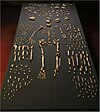 | Dinaledi Chamber hominins | 0.325±0.090[76] | Homo naledi | 2013 | South Africa | Rick Hunter and Steven Tucker | University of the Witwatersrand (South Africa) |
| BH-1 | 0.4[77] | Homo heidelbergensis | Serbia |
Middle Paleolithic: 300,000–50,000 years oldEdit
| Name | Age (ka) | Species | Year discovered | Country | Discovered by | Now located at | |
|---|---|---|---|---|---|---|---|
| Dragon Man | 309–138 | Homo longi | 1933 | China | Hebei GEO University | ||
 | Jebel Irhoud 1–5 | 286±32[78] | Homo sapiens | 1991 | Morocco | ||
 | Samu | 275±25 | Homo heidelbergensis | 1964 | Hungary | László Vértes | |
| [79] | Dali Man | 260±20[80] | Homo erectus or Homo heidelbergensis or early Homo sapiens | 1978 | China | Shuntang Liu | |
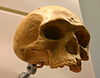 | Florisbad Skull | 259±35 | early Homo sapiens or Homo heidelbergensis or Homo helmei | 1932 | South Africa | T. F. Dreyer, G. Venter | |
 | Galilee Man | 250±50 | Homo heidelbergensis | 1925 | Israel | Francis Turville-Petre | |
 | Saccopastore 1 | 250[81] | Homo neanderthalensis | 1929 | Italy | Mario Grazioli | |
 | Ngandong 7 | 112[82] | Homo erectus | 1931 | Indonesia | C. ter Haar and G. H. R. von Koenigswald | |
| Bontnewydd (Pontynewydd) | 230 | Homo neanderthalensis | 1981 | UK | |||
| Apidima 1 (LAO 1/S1) | 210[83] | Homo sapiens | 1978 | Apidima Cave / Greece | Theodore Pitsios[84] | ||
 | Petralona 1 | 200±40[85] | Homo heidelbergensis (uncertain) | 1960 | Greece | ||
| Omo remains | 195±5[86] | Homo sapiens | 1967 | Ethiopia | Richard Leakey | ||
| Laterite Baby | 190(?)[87] | H. erectus or H. sapiens | 2001 | Tamil Nadu, India | P Rajendran | ||
| Misliya-1 | 187±13[88] | Homo sapiens | 2002 | Israel | Israel Hershkovitz | ||
| Apidima 2 (LAO 1/S2) | 170[83] | Homo neanderthalensis | 1978 | Apidima Cave / Greece | Theodore Pitsios[84] | ||
 | Penghu 1 | 160±30 or 40±30[89] | Homo tsaichangensis[90][91][92] | c. 2008 | Taiwan | National Museum of Natural Science | |
 | Herto remains[93] | 160 | Homo sapiens | 1997 | Ethiopia | Tim White | |
 | Xiahe mandible | 160[94] | Denisovan | 1980 | China | ||
| Altamura Man | 151±21[95] | Homo neanderthalensis | 1993 | Italy | in situ | ||
 | Nesher Ramla Homo | 140–120 | Nesher Ramla Homo or Homo neanderthalensis | 2021 | Israel | Israel Hershkovitz | |
 | LH 18 | 120±30 | Homo sapiens | 1976 | Ngaloba beds at Laetoli, Tanzania | Mary Leakey[96] | |
 | Tabun C1[97] | 120 | Homo neanderthalensis | 1967 | Israel | Arthur Jelinek | |
| Denisova 8 | 110[98][99] | Denisovan | 2010 | Russia | |||
 | Krapina 3[100] | 113.5±13.5[101] | Homo neanderthalensis | 1899 | Croatia | Dragutin Gorjanović-Kramberger | |
 | Broken Hill 1 (Kabwe 1, Rhodesian Man) | 299±25[102] | Homo rhodesiensis (Homo heidelbergensis) | 1921 | Zambia | Tom Zwiglaar | |
 | Qafzeh 6[103] | 95±5[101] | Homo sapiens | 1930 | Israel | R. Neuville, M. Stekelis | |
 | Qafzeh 9 | 100–90[101] | Homo sapiens[104] | 1933 | Israel | T. McCown and H. Moivus, Jr. | |
| Scladina | 103±23[101] | Homo neanderthalensis | 1993 | Belgium | |||
 | Skhul 5 | 100±20 | Homo sapiens | 1933 | Israel | T. McCown and H. Moivus, Jr. | |
| Skhul 9 | 100±20 | Homo sapiens | Israel | ||||
| [105] | Klasies River Caves | 100±25 | Homo sapiens | 1960 | South Africa | Ray Inskeep, Robin Singer, John Wymer, Hilary Deacon | |
 | Eve's footprints | 117 | Homo sapiens | 1995 | South Africa | David Roberts & Lee R. Berger | |
 | Denny[106][107][108] | 90 | Hybrid – (Homo neanderthalensis/Homo sapiens denisova) | 2012 | Denisova Cave / Siberia / Russia | Viviane Slon & Svante Pääbo | Max Planck Institute for Evolutionary Anthropology (Leipzig, Germany) |
| Obi-Rakhmat 1[109] | 75[101] | Homo neanderthalensis | 2003 | Uzbekistan | |||
 | Teshik-Tash Skull[110] | 70 | Homo neanderthalensis | 1938 | Uzbekistan | A. Okladnikov | |
 | La Ferrassie 1 | 70 | Homo neanderthalensis | 1909 | France | R. Capitan and D. Peyrony | |
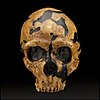 | Shanidar 1 | 70±10 | Homo neanderthalensis | 1961 | Iraq | Ralph Solecki | |
 | La Chapelle-aux-Saints 1 | 60 | Homo neanderthalensis | 1908 | France | A. and J. Bouyssonie and L. Bardon | |
 | Kebara 2 (Moshe)[111] | 60 | Homo neanderthalensis | 1983 | Israel | Lynne Schepartz | |
| [112] | Amud 7 | 55±5 | Homo neanderthalensis | Israel | |||
 | LB 1 (Hobbit) | 55±5 | Homo floresiensis | 2003 | Liang Bua, Indonesia | Peter Brown | |
| Manot 1 | 55 | Homo sapiens | 2008 | Israel | [113] | ||
 | La Quina 5[citation needed] | 52.5±7.5[101] | Homo neanderthalensis | France | |||
 | La Quina 18[citation needed] | 52.5±7.5[101] | Homo neanderthalensis | France | |||
 | Tam Pa Ling Cave[114] | 54.5±8.5[114][115] | Homo sapiens | 2009 | Laos |
Upper Paleolithic: 50,000–11,500 years oldEdit
| Name | Age (ka) | Species | Date discovered | Country | Discovered by | Now located at | |
|---|---|---|---|---|---|---|---|
 | Homo luzonensis | 50±10 | Homo luzonensis | 2007 | Philippines | Florent Détroit & Armand Mijares | |
 | Mungo Man | 50±10 | Homo sapiens | 1974 | Australia | ||
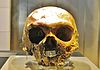 | Mt. Circeo 1[116] | 50±10 | Homo neanderthalensis | 1939 | Italy | Prof. Blanc | |
| SID-00B | 49.2±2.5[117] | Homo neanderthalensis | 1994 | Sidrón Cave, Spain | |||
| Kents Cavern 4 maxilla | 43.5±2.5 | Homo sapiens | 1927 | UK | |||
 | Amud 1[118] | 41[119] | Homo neanderthalensis | 1961 | Israel | Hisashi Suzuki | |
 | Neanderthal 1[120] | 40 | Homo neanderthalensis | 1856 | Germany | Johann Carl Fuhlrott | |
 | Denisova hominin (X-Woman) | 40 | Homo sp. Altai | 2008 | Russia | Johannes Krause, et al. | |
 | hominin toe bone | 40 | Homo sp. Altai (possible Neanderthal-Denisovan hybrid) | 2010 | Russia | ||
 | Oase 1 | 42–37[121] | Homo sapiens (EEMH x Neanderthal hybrid) | 2002 | Romania | ||
| Kostenki-14 (Markina Gora) | 40–37[122] | Homo sapiens (EEMH) | 1954 | Russia | |||
| SID-20[123] | 37.30±0.83[117] | Homo neanderthalensis | 1994 | Sidrón Cave, Spain | |||
| Balangoda man | 37 | Homo sapiens | 2012 | Sri Lanka | |||
 | Hofmeyr Skull | 36 | Homo sapiens | 1952 | South Africa | ||
 | Wadjak 1[124] | 33±4.5[125] | Homo sapiens (proto-Australoid[126]) | 1888 | Indonesia | ||
| Red Lady of Paviland | 33 | Homo sapiens | 1823 | UK | William Buckland | ||
| Yamashita-Cho Man | 32 | Homo sapiens | 1962 | Japan | |||
 | Engis 2 | 40±10[101][127] | Homo neanderthalensis | 1829 | Belgium | Philippe-Charles Schmerling | |
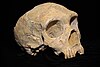 | Gibraltar 1 | 40±10[101] | Homo neanderthalensis | 1848 | Gibraltar | Captain Edmund Flint | |
 | Le Moustier | 40±10 | Homo neanderthalensis | 1909 | France | ||
 | Denisovan tooth | 40±10 | Homo sp. Altai | 2000 | Russia | ||
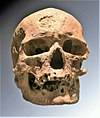 | Cro-Magnon 1 | 30 | Homo sapiens (EEMH) | 1868 | France | Louis Lartet | |
| WLH-50 | 29±5 | Homo sapiens | 1982 | Australia | |||
 | Predmost 3[128] | 26 | Homo sapiens | 1894 | Czech Republic | K.J. Maska | |
| [129] | Lapedo Child | 24.5 | Homo neanderthalensis or Homo sapiens | 1998 | Portugal | João Zilhão | |
| [129] | Eel Point | 24 | Homo sapiens | 1997 | Wales, UK | ||
| MA-1 (Mal'ta boy) | 24 | Homo sapiens (ANE) | 1920s | Russia | |||
 [130] [130] | Minatogawa 1 | 17±1 | Homo sapiens | 1970 | Japan | Anthropology Museum, Tokyo University | |
| Tandou[131][132] | 17 | Homo sapiens | 1967 | Australia | Duncan Merrilees | ||
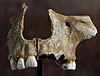 | Gough's Cave[133][134] | 14.7 | Homo sapiens | 2010 | UK | ||
 | Iwo Eleru skull | 13[135] | Homo sapiens | 1965 | Nigeria | ||
| "Kotias"[136] | 13 | Homo sapiens (CHG) | Kotias Klde cave, Georgia | ||||
| Arlington Springs Man | 13[137] | Homo sapiens | 1959 | United States | Phil Orr | ||
 | Chancelade find | 14.5±2.5[138] | Homo sapiens | 1888 | France | ||
| Villabruna 1 | 14 | Homo sapiens (WHG) | 1988 | Italy | |||
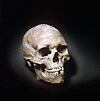 | Bichon man | 13.7 | Homo sapiens (WHG) | 1956 | Switzerland | ||
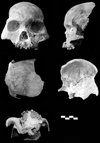 | Red Deer Cave | 13±1.5 | Uncertain, possibly Homo sapiens | 1979 | China | Darren Curnoe? | |
| PES-1[139] | 31-29 | Uncertain, possibly Homo sapiens | Serbia | ||||
| PES-2 | 38.9-92 | Uncertain, possibly Homo neanderthalensis | Serbia |
Holocene (11,500–5,000 years old)Edit
| Name | Age (ka) | Culture / association | Year discovered | Country | |
|---|---|---|---|---|---|
 | Luzia | 11.5[140] | Paleo-Indian | 1975 | Brazil |
| [141] | Cerro Sota 2[142] | 11 | 1936 | Chile | |
| "Satsurblia" | 10 | Caucasian Epipaleolithic (CHG)[136] | Georgia | ||
 | Kow Swamp 1 | 13–9 | 1968 | Australia | |
 | Talgai Skull[143] | 10±1 | 1886 | Australia | |
 | La Brea Woman | 10 | Paleo-Indian | 1914 | United States |
 | Combe Capelle | 9.6 (7600 BC)[144] | European Mesolithic | 1909 | France |
| Asselar man | Between 9500 BP and 7000 BP, with caution, 6390 BP[145] | Neolithic | 1927 | Mali | |
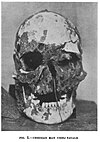 | Cheddar Man | 9 (7000 BC) | British Mesolithic | 1903 | UK |
 | Kennewick Man | 9 (7000 BC) | Archaic period (North America) | 1996 | United States |
 | Tepexpan man | 8±3 | Paleo-Indian | 1947 | Mexico |
 | Loschbour man[146] | 8 (6000 BC) | European Mesolithic (WHG) | 1935 | Luxembourg |
 | Minnesota Woman | 7.9±0.1 | Paleo-Indian | 1931 | Minnesota, United States |
| Lothagam 4b (Lo 4b)[147] | 7.5±1.5[148] | 1965–1975 | Kenya | ||
 | Bessé’[149] | 7.3-7.2 | Toalean | 2015 | Sulawesi, Indonesia |
 | Ötzi | 5.3 (3300 BC) | European Neolithic | 1991 | Ötztal Alps, Italy |
Abbreviations used in fossil catalog nameEdit
- AL – Afar Locality, Ethiopia
- ARA-VP – Aramis Vertebrate Paleontology, Ethiopia
- BAR – (Lukeino, Tugen Hills) Baringo District, Kenya
- BOU-VP – Bouri Vertebrate Paleontology, Ethiopia
- D – Dmanisi, Georgia
- ER – East (Lake) Rudolf, Kenya
- KGA – Konso-Gardula, Ethiopia
- KNM – Kenya National Museum
- KP – Kanapoi, Kenya
- LB – Liang Bua, Indonesia
- LH – Laetoli Hominid 4, Tanzania
- MH – Malapa Hominin, South Africa
- NG – Ngandong, Indonesia
- OH – Olduvai Hominid, Tanzania
- SK – Swartkrans, South Africa
- Sts, Stw – Sterkfontein, South Africa
- TM – Transvaal Museum, South Africa
- TM – Toros-Menalla, Chad
- WT – West (Lake) Turkana, Kenya
| This article uses material from the Wikipedia article Metasyntactic variable, which is released under the Creative Commons Attribution-ShareAlike 3.0 Unported License. |